 WonderLoop
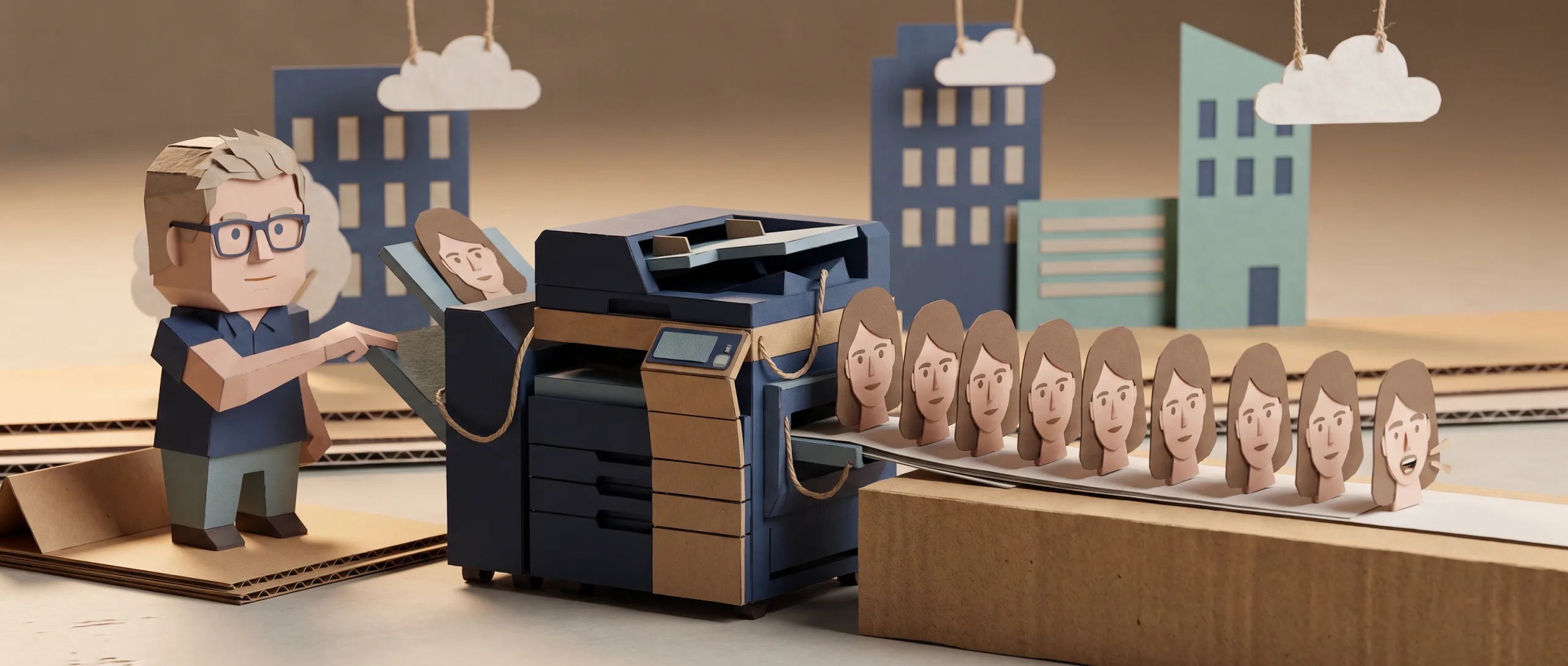
You want a lot of videos. About your product, about the questions customers ask you every week, about that new service nobody knows yet. And you want the same face in all of them, a face people start to recognise after a while.
Only nobody at your company is lining up to sit in front of a camera every week. That's when an AI avatar is a very good idea. One face that talks as soon as there's a script, in any language you need.
But how does that work? And above all: what does it cost?
The short answer: from €1,500. For that you get the avatar set: one person, in a location we create for them, in six images.
If you want that avatar to talk, there are two packages. A VSL, a sales video of two to five minutes, starts at €6,500. The knowledge series package, with one main video plus fifteen short knowledge videos, starts at €9,500. Both include the set. The set itself is ready within two to three weeks.
All three have the same face in them. Which package you need comes down to one question: how often does that face need to come back? Once, sixteen times, every week?
One face is the cheap part
An AI model will spit out more good-looking faces in an afternoon than you will ever need. The work is in the face you pick, and in cleaning it up.
A first image rarely comes out of the machine the way you want it. There's a hand with six fingers, or an earring that gives up halfway down the ear. You take that out by hand.

A detail from an avatar image. This is where the retouching goes: skin, hair, the look in the eyes.
Then we put that face somewhere. In a location that suits your brand, in three shot sizes: full, medium and close. Without those three, there's nothing to cut in a video. And because short videos mostly get watched on a phone, we make every shot twice: landscape in 16:9 and portrait in 9:16. That's six images, and that's the set. Below is Amber's. She's WonderLoop's presenter, and she's an avatar herself.

Amber's set: full, medium and close. 16:9 on top, 9:16 below.
Want the same avatar somewhere else, in different clothes? An extra location with six new images is €900. In a hurry? Express delivery is €400.
If you don't know yet what you'll do with your avatar, start here. Choosing a face is already a decision a marketing team can spend weeks in meetings over. Make that call first.
A made-up face, or yours
That avatar doesn't have to exist. Amber doesn't either. You can have a character made that fits your brand: age, look, clothes, the way it looks into the camera. It never gets tired and never has a bad hair day.

Amber doesn't exist. She still has a busier social life than I do.
You can also have an avatar made of yourself. Only: when you look at it yourself, you'll always see that it's off.
I tried it for my own knowledge videos, with a digital twin of myself next to my iMac. It looked like me, but it moved differently from the way I move. I found it too fake. These days I just record myself again, in front of a green screen.
Your customers won't notice. They don't know how you move; they see someone explaining something. You see it every time, and it's pretty strange. So if anyone tells you the technology is so good that your avatar is exactly you, take it with a grain of salt. It looks like you. It isn't you.
The same face, sixteen times
One image of a face is easy. The second image of the same person is where it falls apart. Suddenly a different nose, a different haircut, a brother you'd never met.
On What?, the AI short I made for the Gemini 3 Film Festival, the whole production came down to this problem. Twenty-two scenes, the same characters in the same clothes, location after location. What solved it was boring prep: a fixed set of close-ups and full-body shots per character, carried into every new scene as reference. I'd love to credit my directing, but it was a folder of photos.

What?: Glenda's reference set, so she stayed the same person in every scene.
That folder of photos is exactly what the avatar set is. And with that set we make the knowledge series.
A knowledge video is a video of up to one minute that answers one question your customers ask. Each one covers one topic and is made to be watched upright on a phone. What does a service cost? How long is delivery? Why are you pricier than the guy next door?
The knowledge series package starts at €9,500. For that you get the set, one main video of up to 90 seconds in 16:9, and fifteen knowledge videos. You get help with the scripts, and the cost of HeyGen, the software that makes the avatar talk, is included.
Why fifteen? Because one video does nothing. At one knowledge video a week, the same face spends almost four months answering questions. That's how people get to know it, and you get found on exactly the questions they type in.
The same series works inward too, as onboarding for new customers or new staff. They ask the same questions every time anyway.
If you use the face once for a launch and never again, you don't need an avatar. You need a video with an AI character in it, which is a different conversation with a different price.
A voice turns it into a person
Talking is harder than posing. A still face only has to get one thing right. A talking face has to get everything right at once: the lipsync, the eyes, the small movements of the head, and a voice that belongs to that face.
People underestimate the voice. Take Amber again. She explains every step on the production roadmap you get when you work with me. Her image comes from HeyGen, her voice from ElevenLabs, and it's always the same voice. As far as I'm concerned that's half the character. A face you recognise with a voice that changes every time is a badly dubbed cartoon.
Left: Steven and Amber, talking with lipsync. Right: Steven as a model in a webshop demo.
If you want to keep making videos yourself after the series, you can add a HeyGen training. Then you make the next video without me. Commercially that's an odd tip. But if you need lots of short videos after that, it's the route I'd take myself.
A sales video you keep rewriting
A VSL is a sales video of two to five minutes, usually on a landing page. A good one is hard to make, and the hard part is the script. Why would anyone still be watching after two minutes?
That's why a VSL with me starts with an intake: what you sell, to whom, and what stops people from buying. Only then do I write.
And then it still isn't done. I'd love to say my first version always lands, but nobody's does. You test it and see where people drop off. Then you rewrite. With a camera that means another shoot day. With an avatar, a new script is just a new render.
The package starts at €6,500. For that you get the set and one VSL in 16:9, with on-screen text, b-roll, subtitles and music. You also get three alternative openings: three different versions of the first twenty seconds, so you can test which one holds people. HeyGen is included, and so are one big and two detail feedback rounds. Longer than five minutes works too; then I'll price it to fit.
Where the bill really climbs
The same video in German, French or another language, with the same face and the same voice, is €800 for a main video or VSL and €300 per knowledge video. That buys a complete version: the voice-over in that language, the avatar re-rendered so the lips match, all on-screen text and the subtitles, a separate render and one correction round. Someone on your side who really speaks the language approves the translation before we render.
If it were my own money, this is how I'd do it. If you don't know yet what the avatar should do, start with the set and see where the face works. If you do know, go straight for the series or the VSL. The set is included, so nothing gets thrown away.
What I wouldn't do: order a VSL, a series and three languages in one go for a face that hasn't appeared anywhere yet. Then you're paying to repeat something before you know you want to repeat it. The digital avatars page has the packages side by side, with the full process.
The face was never the expensive part. Coming back is.